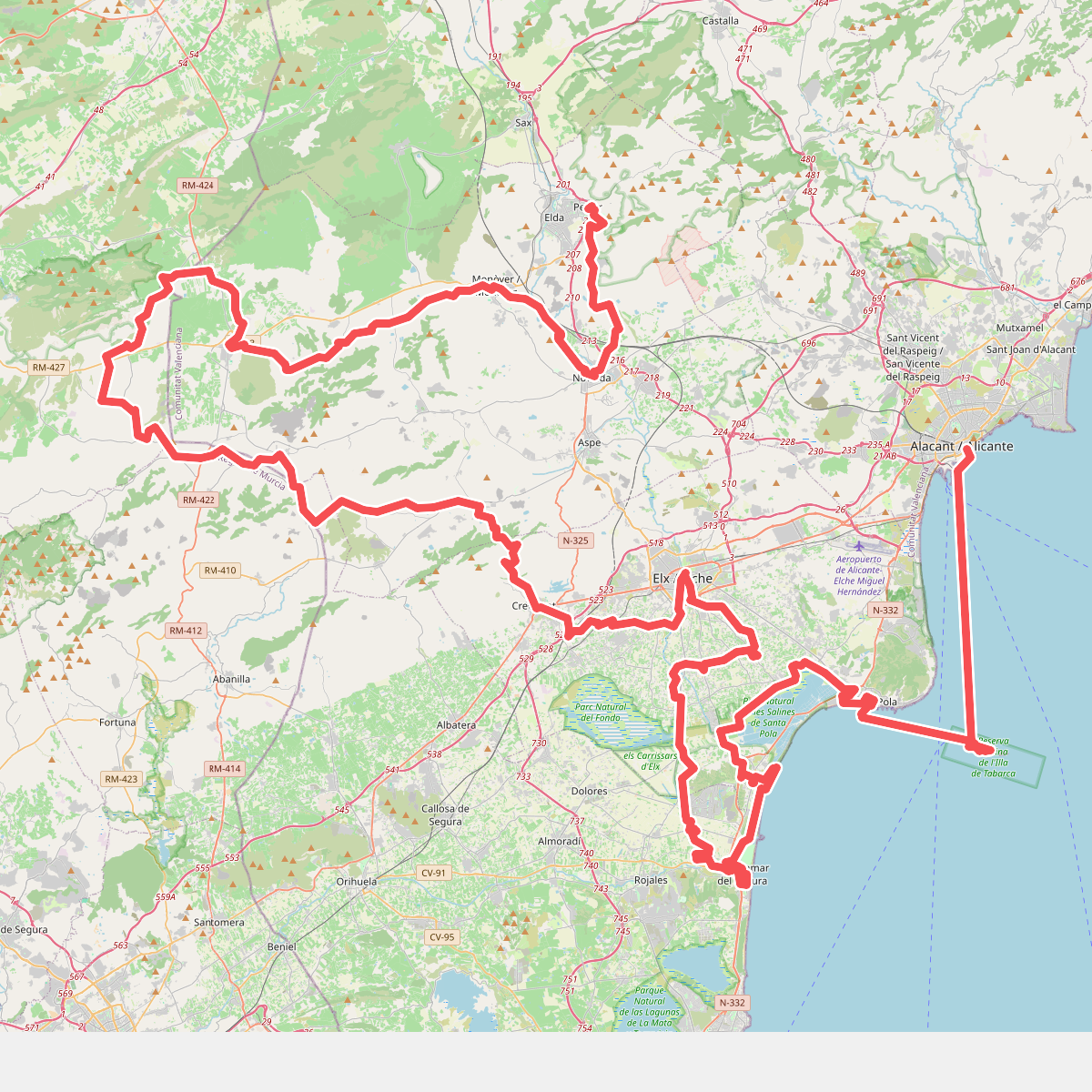
The best hiking routes in Parc Natural del Fondo
Discover the best walks in Parc Natural del Fondo. 1 routes on the map, with descriptions, photos and GPX.
About Parc Natural del Fondo
Parc Natural del Fondo is a heavily managed wetland landscape shaped by historical agricultural irrigation and reservoir construction. Unlike natural coastal marshes, this reserve consists of two large, embanked water storage basins surrounded by a network of canals, reedbeds, and salt-tolerant scrub. Walkers will find a flat, low-lying terrain where the view is dominated by tall reeds and open water surfaces rather than trees or hills.
Read more
About Parc Natural del Fondo
Parc Natural del Fondo is a heavily managed wetland landscape shaped by historical agricultural irrigation and reservoir construction. Unlike natural coastal marshes, this reserve consists of two large, embanked water storage basins surrounded by a network of canals, reedbeds, and salt-tolerant scrub. Walkers will find a flat, low-lying terrain where the view is dominated by tall reeds and open water surfaces rather than trees or hills.
Read moreParc Natural del Fondo is a heavily managed wetland landscape shaped by historical agricultural irrigation and reservoir construction. Unlike natural coastal marshes, this reserve consists of two large, embanked water storage basins surrounded by a network of canals, reedbeds, and salt-tolerant scrub. Walkers will find a flat, low-lying terrain where the view is dominated by tall reeds and open water surfaces rather than trees or hills.
Underfoot, the walking conditions depend entirely on the chosen route. The main access routes consist of wide, flat gravel tracks and raised wooden boardwalks that lead to elevated wooden bird hides. Away from these developed paths, the terrain transitions into dirt tracks that can be dusty or muddy depending on the season. There are no steep climbs or rocky paths here, only level walking alongside slow-moving water channels.
In winter, particularly around January, the open reservoirs host thousands of wintering waterfowl, making the bird hides the main focus of a visit. During these months, the vegetation is dry and brown, contrasting with the green saltwort and glasswort shrubs that cover the saline soils. It is a functional, engineered wetland where the sound of water management infrastructure is part of the environment, offering a specialized walk focused on birdwatching rather than varied topography.