

The best hiking routes in SIC Selva del Lamone
Discover the best walks in SIC Selva del Lamone. 5 routes on the map, with descriptions, photos and GPX.
About SIC Selva del Lamone
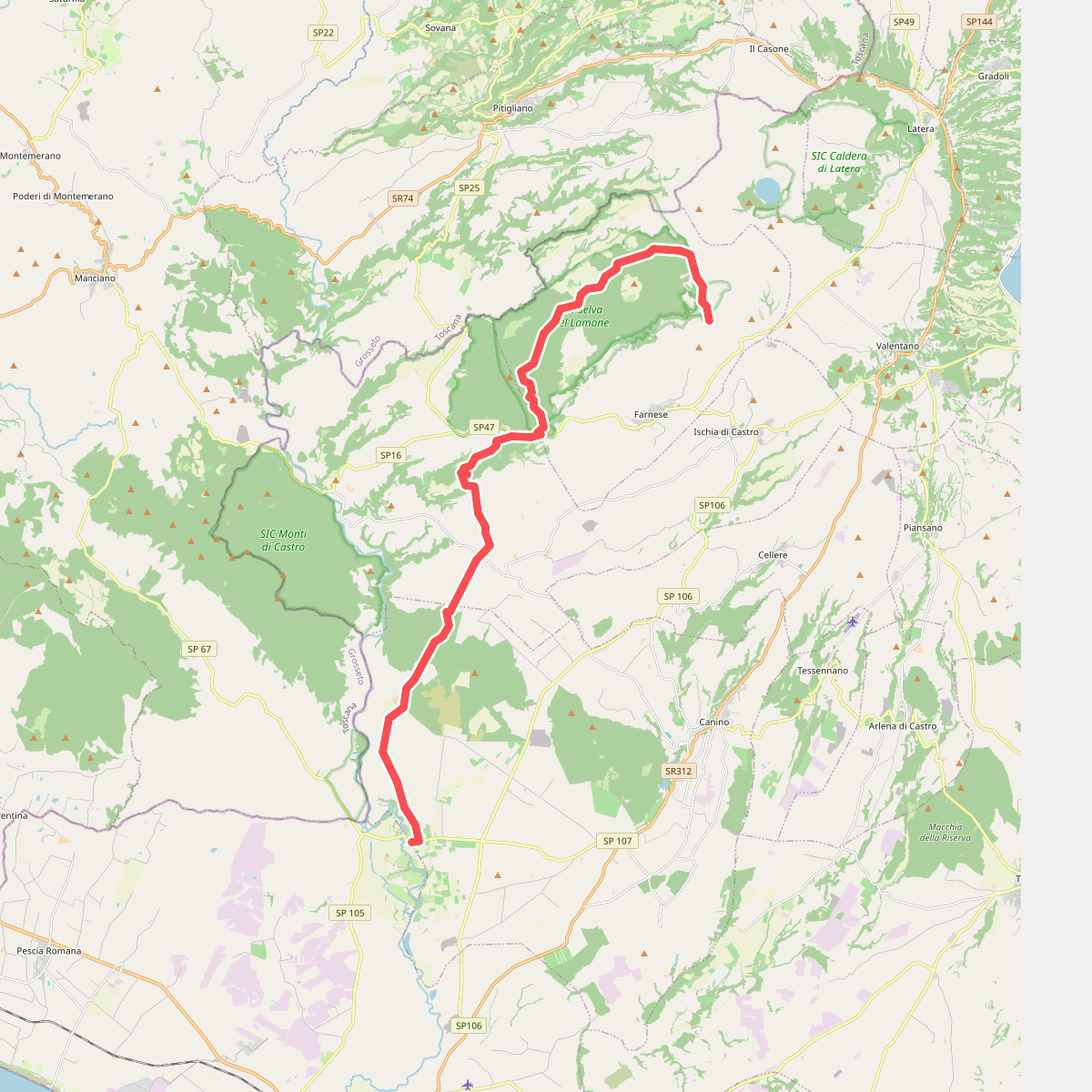
SIC Selva del Lamone is a dense, rugged forest growing over an ancient, fractured lava flow. Walkers should expect a flat but highly uneven landscape where the path is constantly interrupted by jagged basalt boulders, moss-covered stone heaps, and sinkholes. Unlike open Tuscan hillsides, this reserve offers a closed, almost monolithic canopy of Turkey oak and hornbeam that keeps the interior shaded and humid. The terrain requires constant attention to footing, as you will be stepping over loose volcanic rocks and navigating narrow, unpaved dirt tracks rather than wide, smooth gravel roads.
Read more
About SIC Selva del Lamone
SIC Selva del Lamone is a dense, rugged forest growing over an ancient, fractured lava flow. Walkers should expect a flat but highly uneven landscape where the path is constantly interrupted by jagged basalt boulders, moss-covered stone heaps, and sinkholes. Unlike open Tuscan hillsides, this reserve offers a closed, almost monolithic canopy of Turkey oak and hornbeam that keeps the interior shaded and humid. The terrain requires constant attention to footing, as you will be stepping over loose volcanic rocks and navigating narrow, unpaved dirt tracks rather than wide, smooth gravel roads.
Read moreSIC Selva del Lamone is a dense, rugged forest growing over an ancient, fractured lava flow. Walkers should expect a flat but highly uneven landscape where the path is constantly interrupted by jagged basalt boulders, moss-covered stone heaps, and sinkholes. Unlike open Tuscan hillsides, this reserve offers a closed, almost monolithic canopy of Turkey oak and hornbeam that keeps the interior shaded and humid. The terrain requires constant attention to footing, as you will be stepping over loose volcanic rocks and navigating narrow, unpaved dirt tracks rather than wide, smooth gravel roads.
The forest floor is characterized by its chaotic geology, where the collapsed lava tubes have created a labyrinth of small ridges and depressions. You will notice how the vegetation adapts to this rocky substrate, with ferns and mosses colonizing the damp crevices while sturdy oaks grip the thin soil. There are no panoramic viewpoints or sweeping vistas here; the appeal lies in the enclosed, primeval atmosphere of the dense woodland and the physical challenge of navigating the stony ground.
During winter and early spring, the lack of leaves allows more light to reach the basalt formations, making the volcanic ruins and old stone enclosures built by past herdsmen easier to spot. In summer, the canopy closes completely, trapping moisture and creating a quiet, shaded environment. This area is best suited for those who prefer rough, technical walking over uneven stones and want to experience a wild, geologically distinct forest rather than a manicured park with signposted amenities.