

The best hiking routes in Nassau
Discover the best walks in Nassau. 63 routes on the map, with descriptions, photos and GPX.
About Nassau
The Nassau nature area offers a landscape of contrasts, defined by its transition from dry, sandy pine forests to low-lying, damp heathlands. Walkers will notice how the terrain shifts underfoot from soft, deep sand tracks on the higher ground to firmer, damp soil in the depressions. The area is not a place of dramatic elevation changes or deep valleys, but rather a gently undulating plain where subtle ridges of inland dunes rise just a few metres above the surrounding flats.
Read more
About Nassau
The Nassau nature area offers a landscape of contrasts, defined by its transition from dry, sandy pine forests to low-lying, damp heathlands. Walkers will notice how the terrain shifts underfoot from soft, deep sand tracks on the higher ground to firmer, damp soil in the depressions. The area is not a place of dramatic elevation changes or deep valleys, but rather a gently undulating plain where subtle ridges of inland dunes rise just a few metres above the surrounding flats.
Read moreThe Nassau nature area offers a landscape of contrasts, defined by its transition from dry, sandy pine forests to low-lying, damp heathlands. Walkers will notice how the terrain shifts underfoot from soft, deep sand tracks on the higher ground to firmer, damp soil in the depressions. The area is not a place of dramatic elevation changes or deep valleys, but rather a gently undulating plain where subtle ridges of inland dunes rise just a few metres above the surrounding flats.
In the wetter sections of Nassau, particularly during the late summer month of August when the heather is in purple bloom, the paths are often reinforced with simple wooden boardwalks to help you cross the boggy patches. These damp zones are characterised by peat moss and gorse, which contrast sharply with the dry, open lichen fields found on the sandy drifts. The forest sections consist mainly of Scots pine, planted decades ago, which now self-seed alongside native birch trees.
This area is generally quieter than the more famous dune reserves along the coast, though the main trailheads can see more activity at weekends. Walking here requires an eye for small-scale variation, as the vegetation changes rapidly within just a few hundred metres. It is a reliable choice for those who prefer straightforward, level walking on a mix of sandy tracks and forest paths without steep climbs.
Hiking routes in Nassau (63)

#1. 4 Bäche Runde bei Montabaur - Eisenbach -Gelbach - Ahrbach - Holbach
Girod,Steinefrenz,Großholbach

#2. [5] HWW Westerwald Herdorf - Diez
Nentershausen,Eppenrod,Görgeshausen,Hambach,Heistenbach,Diez
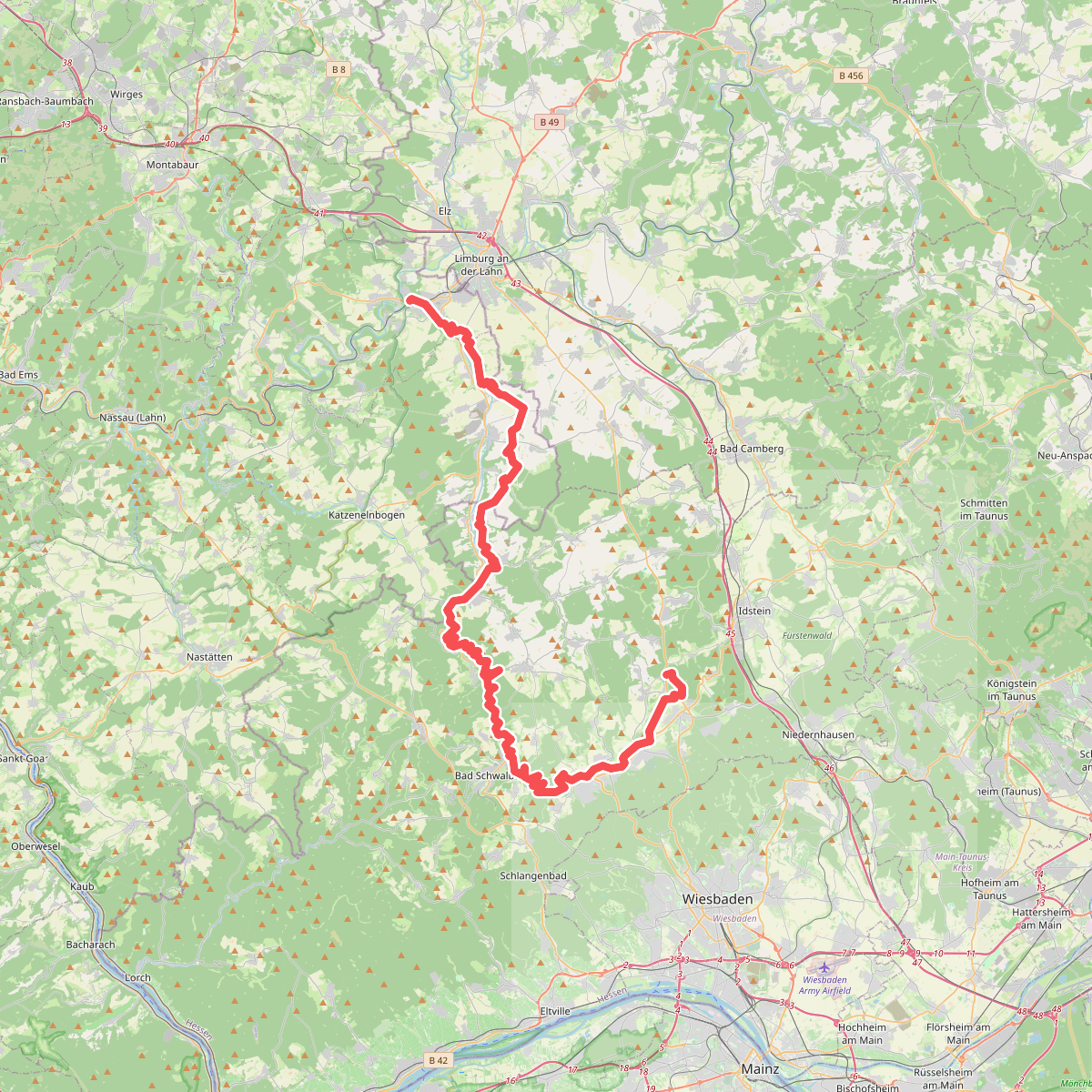
#3. Aar-Höhenweg
Taunusstein,Hohenstein,Bad Schwalbach,Burgschwalbach,Hahnstätten,Netzbach,Oberneisen,Niederneisen,Holzheim,Diez

#4. Boppard - Oberwesel
Boppard,Halsenbach,Karbach,Hungenroth,Sankt Goar,Urbar,Niederburg,Oberwesel

#5. Bopparder Ansichten
Boppard

#6. Dachsenhäuser Runde
Dachsenhausen,Oberbachheim,Niederbachheim

#7. Damschaufel
Rettert

#8. Dörsbach Mühlenwanderweg
Obernhof,Seelbach,Singhofen,Attenhausen,Kördorf,Herold,Ergeshausen,Klingelbach,Katzenelnbogen

#9. Elchwanderweg Elgendorf (Große Umrundung)
Montabaur

#10. Elchwanderweg Elgendorf (Kleine Umrundung)
Montabaur,Dernbach (Westerwald)

#11. Europäischer Fernwanderweg E8, Rheinland-Pfalz